

The problem
Masjid Kariah Matang Gedong kept its kariah register on paper. A household was a form in a file — name, IC, spouse, children, income band, address — and finding one meant knowing which file it was in.
That made the ordinary questions expensive. How many households are registered? How many warga emas? How many families in each zone? Every answer had to be counted by hand, so in practice nobody asked.
The mosque's money had the same shape: several funds, one book, and a monthly statement the bendahari assembled manually.
What we observed
Before we wrote any code.
We sat with the AJK before designing anything, and three things decided the build.
The paper form was already right. People knew it, and it asked for things most systems drop — dependants, waris, income band, tanggungan. So we rebuilt it field for field instead of inventing a tidier one.
The person filling in the form is usually not the person who owns the data. A committee member registering a household at a drive is typing someone else's IC. Email-based accounts would have failed on day one, so the IC number became the login.
And nothing could be quietly lost. Any change to a member's record has to be attributable months later.
What we built
A kariah registry that mirrors the paper form field for field: household plus dependants and waris, IC-number login instead of email, document upload per slot, and a duplicate detector that catches the same person registered twice at two different drives.
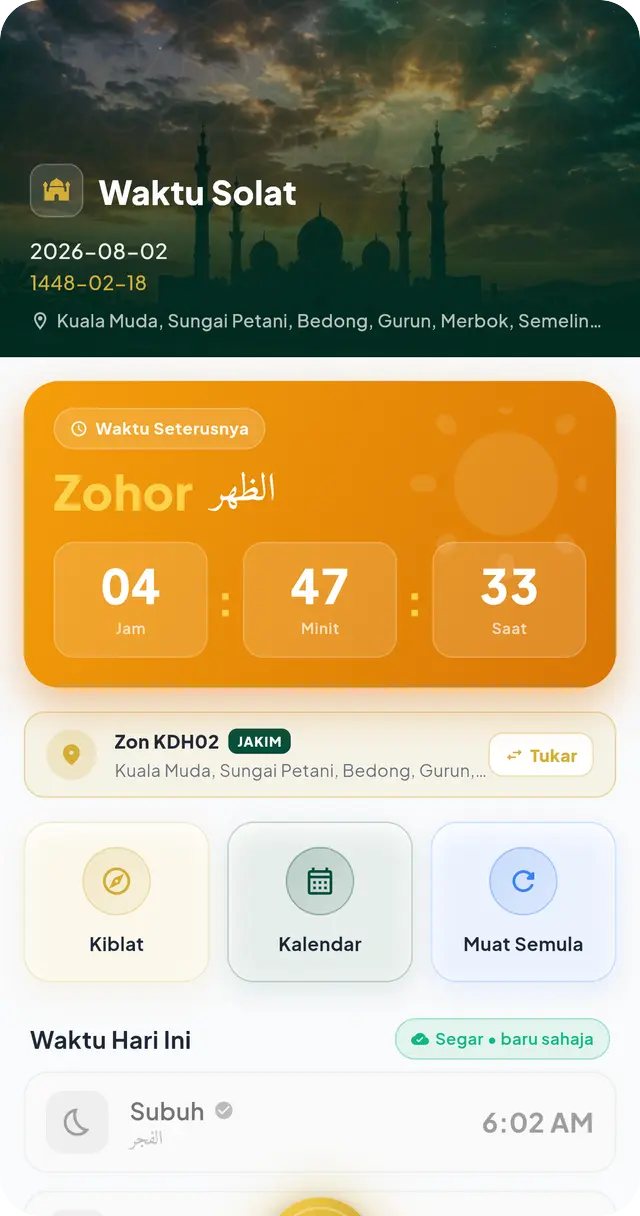
Around the registry sits the rest of the mosque's admin — fund accounting across the mosque's tabung with a monthly statement in the bendahari's own format, online infaq with receipts issued automatically, prayer times and azan notifications by JAKIM zone, khutbah and imam rosters, a death and takziah workflow, and member cards with QR verification.
Every change anyone makes is written to an audit log.
Before vs after
The same job, the old way and the new way.
Before
After
Results
Counted from the production database on 2 August 2026. 641 app accounts have been created against those households.
Screenshots
More like this
Related work
 Mobile App
2026
Mobile App
2026
MyCuciRapi
On-demand home cleaning, booked in seconds
 Mobile App
2026
Mobile App
2026
Builtech · BPM Tracker
Construction project management, reinvented
 Mobile App
2026
Mobile App
2026
CostBuddies
Know the true cost of every dish
Build something similar
Let's build yours.
Tell us what you're planning. Free 30-minute call, a written scope and a fixed quote — we reply within one working day.