
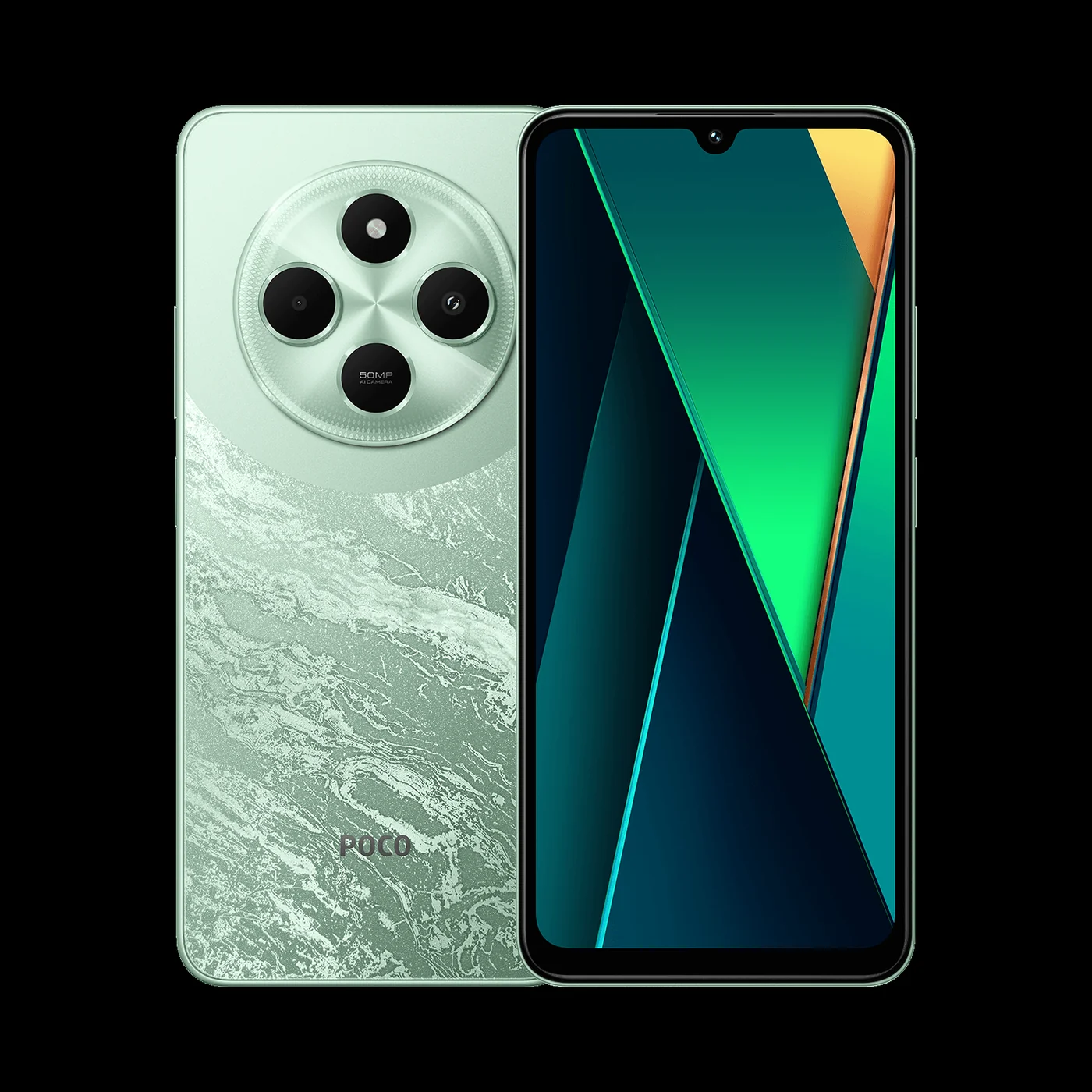
The Redmi costs RM549 — about $115 — at a Xiaomi store in Kuala Lumpur's Mid Valley Megamall, and for the first ten minutes it feels like theft. A 120Hz screen. A 108-megapixel camera. A battery that outlasts your workday. Then you finish setup, and the phone starts introducing itself properly.
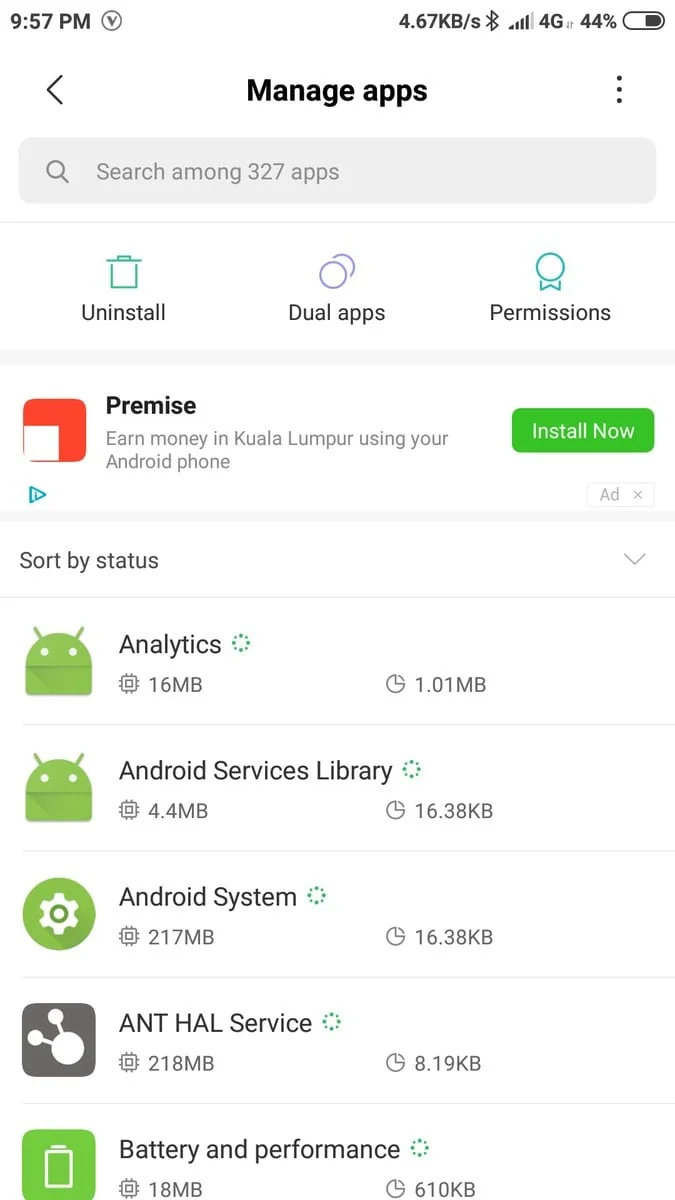
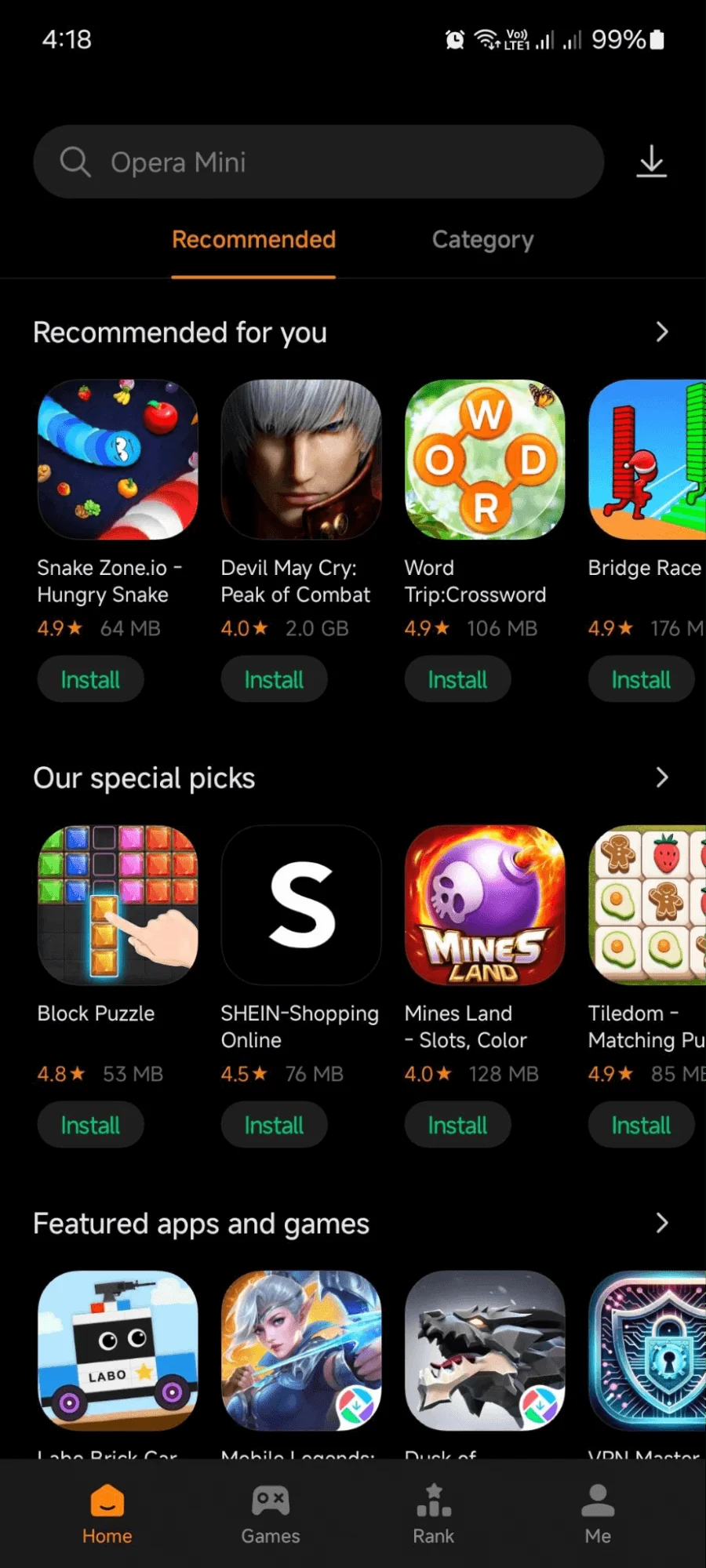
Open the Security app — the utility that's supposed to scan for malware — and there's a full-width banner ad waiting beneath your scan results, plus a carousel of "recommended" games. The File Manager has a content feed. The Downloads folder suggests apps you never asked about. Your app folders arrive pre-decorated with a row of "promoted" icons. Somewhere in the notification shade, an app store called GetApps is already letting you know about a hot new puzzle game. And the first time you wake the lock screen, it isn't showing your wallpaper — it's showing a glossy image carousel with what is very obviously sponsored content tucked between the travel photos.
None of this is a malfunction. None of it is a bug that slipped past quality control. Every banner, every pre-installed game, every promotional push notification is a line item in one of the most successful business models in consumer electronics — a model in which the phone in your hand is not really the product. It's the storefront.
So who actually pays for a RM549 phone? You do. Just not at the register.
The 5% promise
On April 25, 2018, standing on a stage at Wuhan University, Xiaomi founder Lei Jun made a promise that no hardware CEO had ever made: the company "will forever limit the net profit margin after tax for our entire hardware sales … to a maximum of 5%," and if it ever earned more, it would "distribute the excess amount by reasonable means to its users" (TechCrunch). Weeks later the pledge was written into the IPO prospectus for what became one of Hong Kong's biggest tech listings: "If the net margin exceeds 5%, we will return the excess to our users" (Pandaily).
It read like altruism. It was actually a disclosure document.
Read the fine print and the cap applies only to net margin on hardware. It says nothing about the other business — the one described in the same prospectus with unusual candor: "Xiaomi is an internet company with smartphones and smart hardware connected by an IoT platform at its core." Xiaomi's then-India boss Manu Kumar Jain put it even more plainly in 2019: "we are an internet company and the hope and aim is to make money from these internet services and not by selling hardware … our job actually starts when you sell a smartphone" (Hindustan Times). Your phone, in other words, is customer acquisition. You are the recurring revenue.
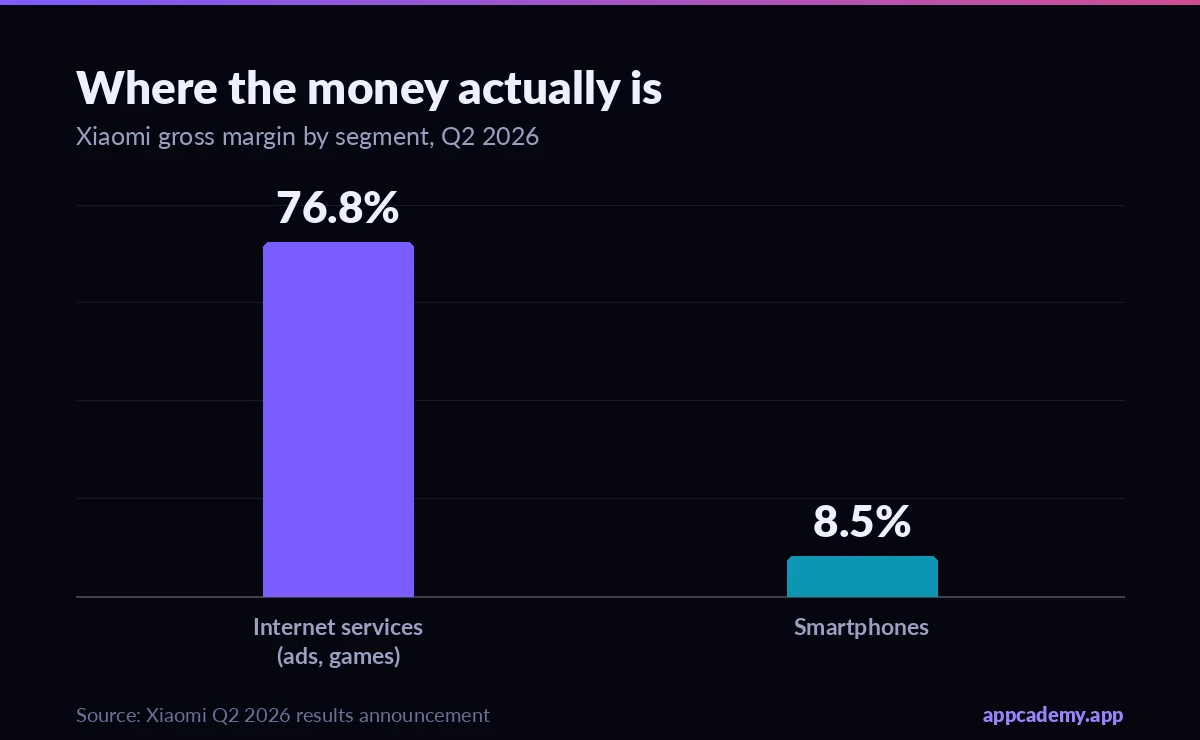
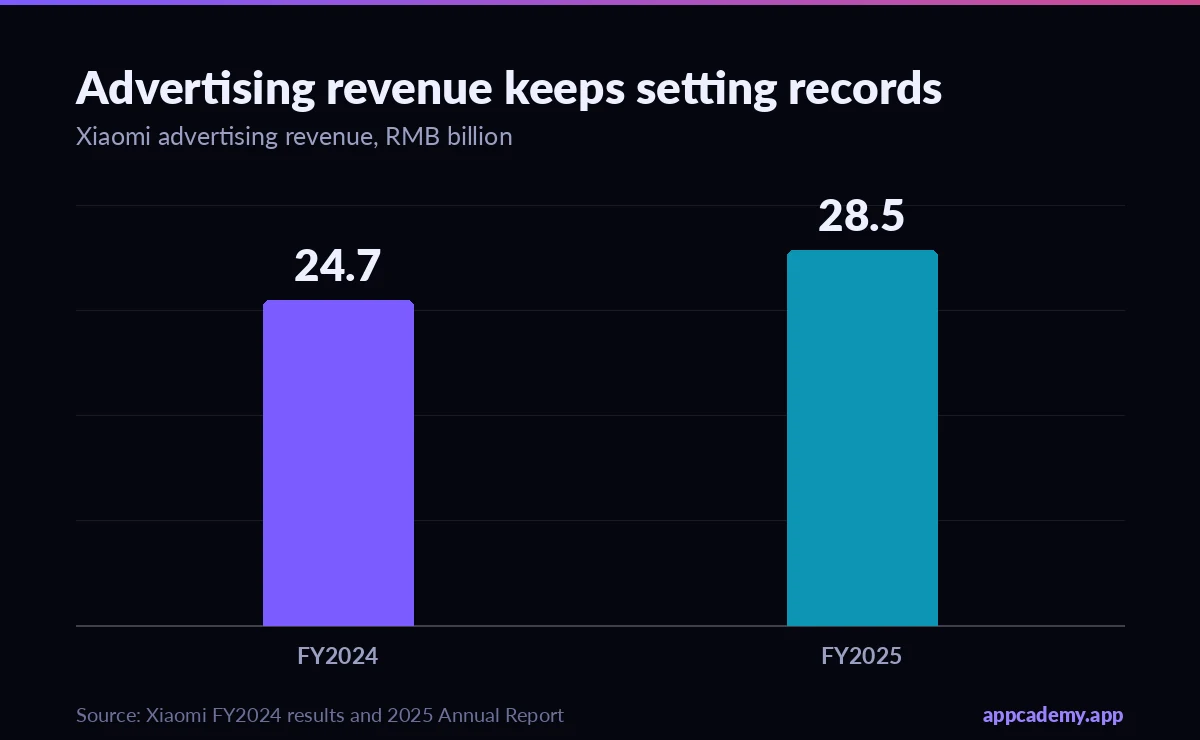
The financial statements make the loop brutally visible. In FY2024, Xiaomi's internet services segment — advertising, games and other value-added services — brought in RMB 34.1 billion at a gross margin of 76.6%, of which advertising alone was a record RMB 24.7 billion, up 20.5% year over year (Xiaomi FY2024 results). In FY2025, internet services hit RMB 37.4 billion at a 76.5% gross margin, with advertising reaching another record of RMB 28.5 billion, up 15.2% — while the hardware side duly reported a net margin of 2.3%, "fulfilling our pledge" (Xiaomi 2025 Annual Report). By Q2 2026 the divergence was almost comedic: smartphone gross margin had sagged to 8.5% on rising memory costs, while internet services hummed along at 76.8%, with the company attributing the segment's profitability to "the increased gross profit margin and higher revenue contribution of our advertising business" (Xiaomi Q2 2026 results).
A quick translation of those numbers: for every RMB 100 Xiaomi earns showing you ads and selling you game items, about RMB 76 is gross profit. For every RMB 100 of phones it sells you, it keeps maybe nine. The cheap phone is not the business. The cheap phone is the cost of acquiring the business — which is you, your lock screen, and the 754 million other monthly active users Xiaomi counted in December 2025.
And here's the part that matters: the subsidy loop only closes if the ads stay on. Which brings us to where they live.
A guided tour of your ad-supported phone
Xiaomi's software — MIUI for a decade, now rebranded HyperOS — treats nearly every system surface as sellable real estate. A ROM, for the uninitiated, is the operating-system build that ships on the phone; "bloatware" is the cargo of pre-installed apps that ride along with it, most of them paid placements rather than engineering choices.
The tour starts with a background service called MSA — officially "MIUI System Ads," a name so on-the-nose that the first step in every de-ad guide on the internet is revoking its authorization (Gizmochina). MSA orchestrates the recommendations that surface in the Security app (including ads shown after malware scans, arguably the one moment a security tool should feel least commercial), the File Manager, Downloads, Themes, the Mi Browser homepage feed, Mi Music, Mi Video, the Weather app, and the App Vault minus-one screen. App folders sprout "promoted apps." GetApps — Xiaomi's own app store, sidelined but never silent on global phones — pushes notifications. Ads once appeared in the Settings app itself, in 2018, before a user revolt forced a rollback; Xiaomi's statement at the time is worth keeping in a frame: "Advertising has been and will continue to be an integral part of Xiaomi's Internet services, a key component of the company's business model" (The Verge).
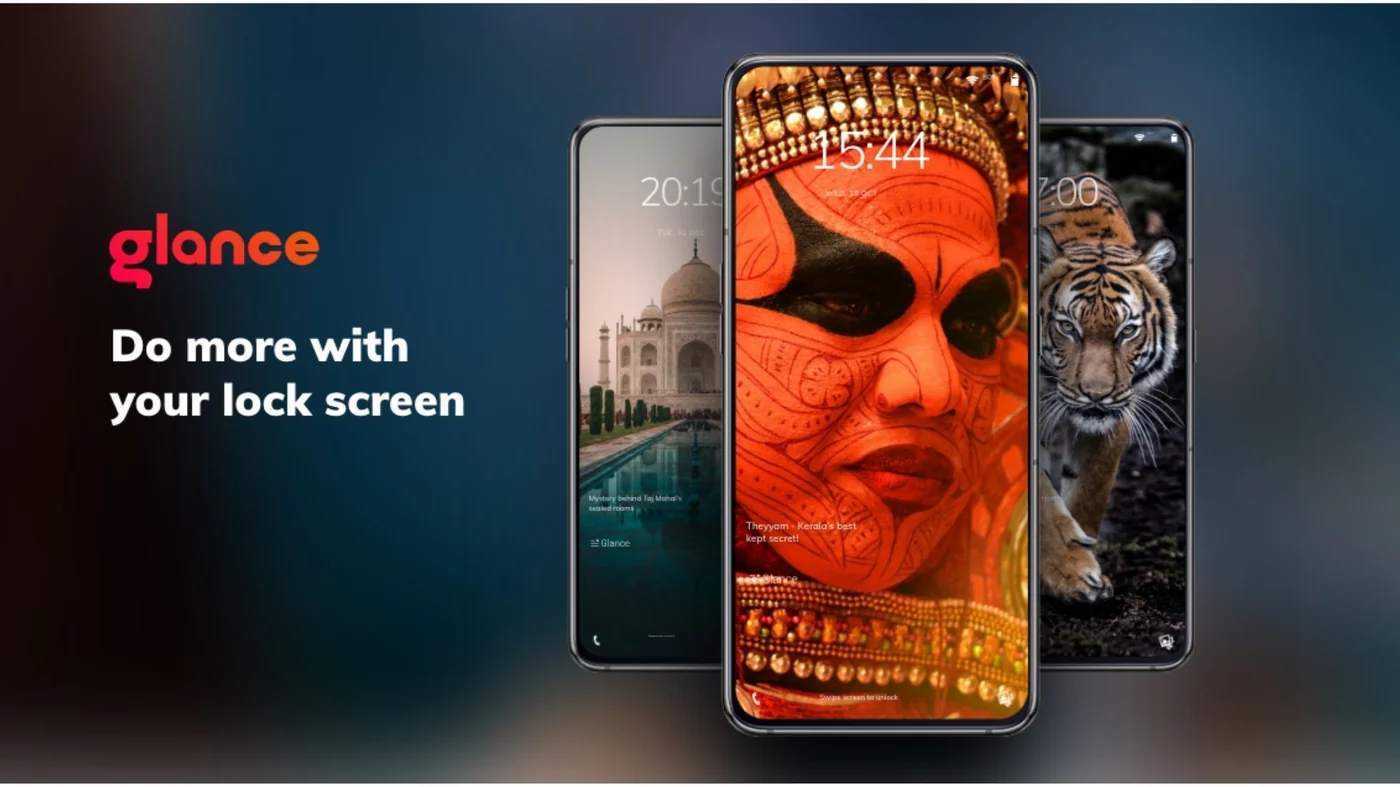
The lock screen is a business of its own. On Xiaomi phones in India, Southeast Asia and other emerging markets, it's often powered by Glance — a content platform from Indian ad-tech firm InMobi, backed by Google, Jio and SoftBank — which reported 235 million active users as of March 2024, with roughly 10% of its lock-screen content being promotional (Economic Times). On other ROMs the same slot is filled by Xiaomi's own Wallpaper Carousel. Either way, the first screen you see a hundred times a day is inventory.
Then there's the cargo hold. A typical Redmi or POCO ships with Facebook's app plus three Facebook background services, Netflix, LinkedIn, and a stack of casual games alongside Xiaomi's own suite. This isn't generosity. Xiaomi's own Q3 2018 earnings announcement credited surging ad growth partly to "higher pre-installation revenue" — third parties paying for placement on your home screen (Xiaomi Q3 2018 results). Reuters, reporting on India's proposed pre-install rules, noted drily that phone makers "sometimes pre-install others with which they have monetisation agreements" (Gadgets360/Reuters). The practice is now so industrialized that agencies like AVOW and Xiaomi's own Mi Ads platform sell "dynamic preloads," push-notification slots and app-store placements by the campaign, pitching Xiaomi inventory as "particularly strong in emerging markets like India, Southeast Asia, and Eastern Europe" (QiAds).
Could Xiaomi add a single switch that turns it all off? Users have begged for one for years. In August 2024, while promising to reduce pre-installed apps on upcoming flagships, the company gave its answer: no. "We aren't currently planning to add a toggle that realistically, only a small amount of users would discover and use," it said (AndroidKenya). A master kill switch has surfaced only in leaked test builds, never in a shipping release (AndroidAyuda). Remember that detail. It will matter when we get to Samsung.
Meanwhile, in China
To understand why the ads exist at all, you have to look at the market where the model was perfected — because China's mobile internet is a parallel universe with different physics.
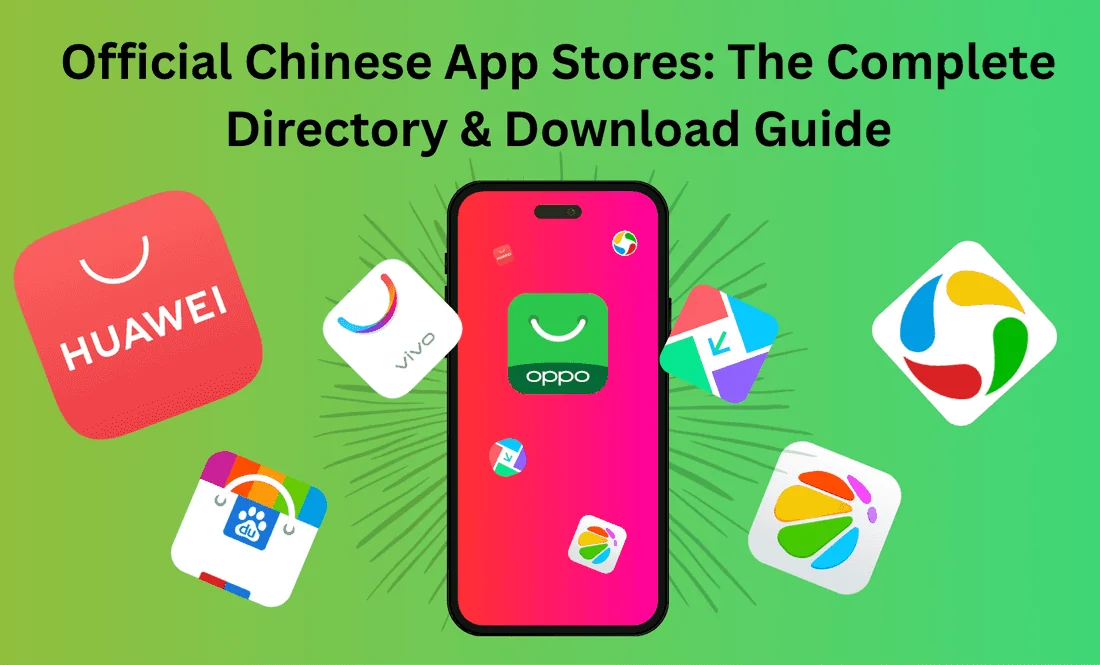
Start with an absence. Google pulled its search engine out of mainland China in March 2010, and the Google Play Store has been blocked there since roughly 2012 (AppInChina). No Play Store means no single tollbooth for apps. Into that vacuum rushed chaos: at the peak, several hundred Chinese Android app stores competed for downloads, and even today somewhere around 25 major ones remain, with the top five or six covering roughly 80% of the Android audience.
The landscape that emerged is dominated by the phone makers themselves. Huawei's AppGallery leads most estimates (one index puts it at ~27% share and 340 million monthly users; other trackers put it at 25% or as high as 44% — there is no authoritative series, so treat every percentage as directional), followed by vivo's store, Tencent's Yingyongbao, Xiaomi's GetApps and OPPO's Software Store (AppInChina App Store Index). The old independent stores are dying in public: Baidu paid $1.9 billion for app-store pioneer 91 Wireless in 2013, when Baidu's channel held 40.6% of the market; the last 91 services were switched off on September 27, 2025, a quiet funeral for the third-party era (Global Times; iReaShare).
But the defining feature of the Chinese ecosystem isn't the number of stores. It's the tax.
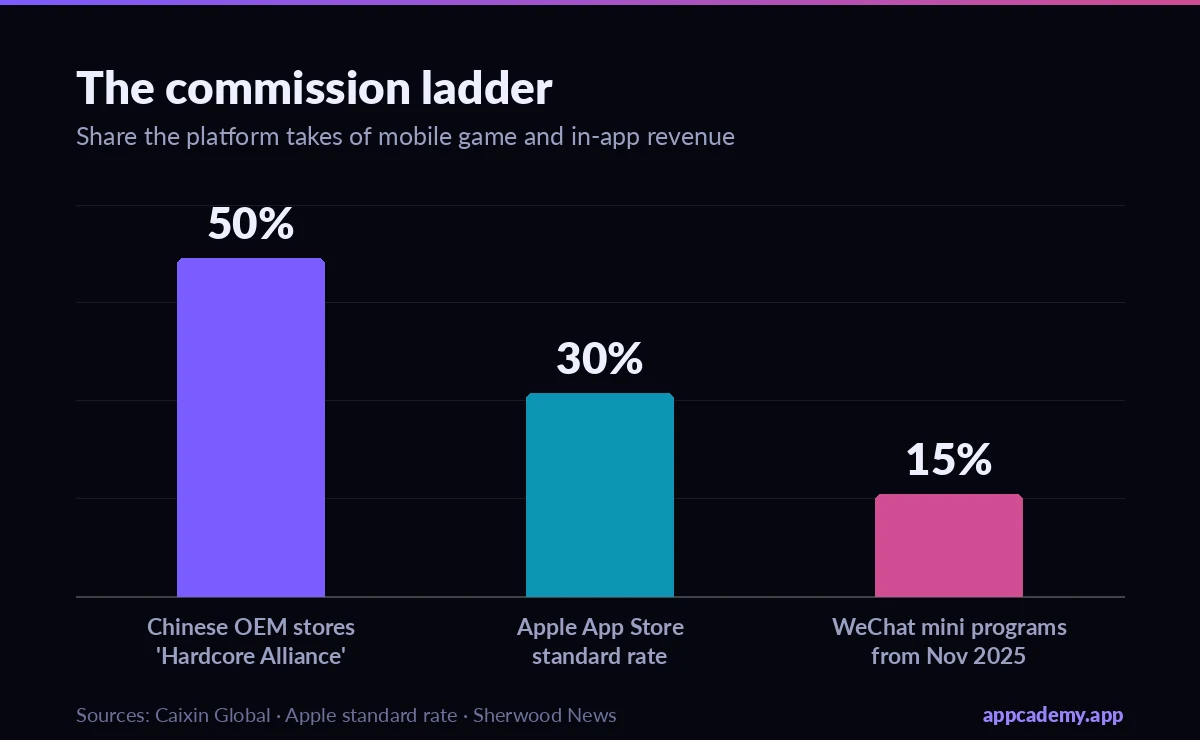
Since 2014, a bloc called the Hardcore Alliance — Huawei, OPPO, vivo and partners, founded August 1 that year — has enforced a standardized 50:50 revenue split on mobile games distributed through their stores. Fifty percent. Apple's famous App Store commission, the one that got it sued on multiple continents, is 30%. Xiaomi never formally joined the alliance but charges the same rate; Caixin confirmed that Xiaomi, Qihoo 360, Baidu and Yingyongbao all adopted the 50-50 model (Caixin Global). Chinese developers call it the 安卓税 — the "Android tax" — and after channel fees and withheld taxes, studios say they often keep under 30 cents of every yuan.
The giants have finally had enough. In June 2024, Tencent pulled its blockbuster mobile title Dungeon & Fighter: Origin from the Huawei, OPPO and vivo stores — some reports, including Reuters' wire, listed Xiaomi among them; other reporting notes Xiaomi was excluded — telling players to download the game from its own website instead (Reuters). miHoYo had already launched Genshin Impact and Zenless Zone Zero bypassing the alliance entirely, via official sites and the zero-commission TapTap store. Then, in the autumn of 2025, NetEase yanked essentially its whole catalog, including Fantasy Westward Journey and Justice Mobile, from the OPPO, vivo and Xiaomi channels (Futu News). The CEO of TapTap's parent company explained why developers run: "Listing on domestic Android channels means losing half our revenue, and our official website packages even get secretly replaced with revenue-sharing channel packages during installation" (TechNode). Read that again: if you download a game from the developer's own website, the phone's software may swap in a store version at install time so the handset maker gets its cut. In China, "open" Android means the freedom to be taxed by whoever made your phone.
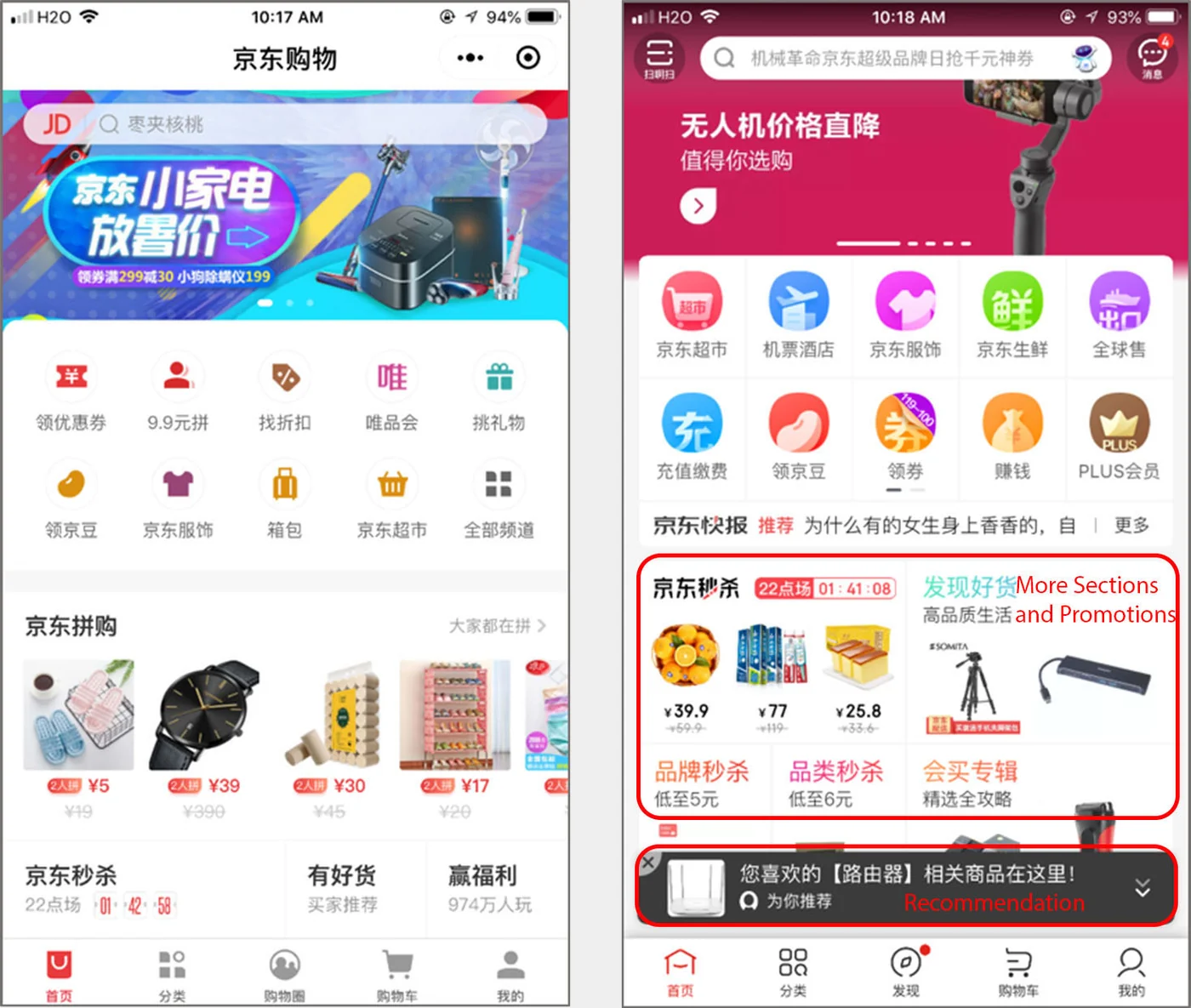
The bigger jailbreak, though, isn't APK files — it's WeChat. Mini programs, lightweight apps that run inside Tencent's super-app with no store install at all, reached about 945 million monthly active users in 2024 and did over RMB 2 trillion in transactions in the third quarter of 2024 alone (DemandSage; CIW). Mini games — casual games that never touch an app store — count over 500 million monthly users. Even Apple, which spent 2024 reportedly threatening to reject WeChat updates over the bypass, settled in November 2025 for a 15% commission on mini-program purchases, half its standard rate (Sherwood News). When the world's most profitable platform holder accepts half price, the app store's grip is genuinely loosening.
Layered on top of all this is the state's own plumbing. Since September 2023, every app and mini program serving users in China must complete a government record filing — the 备案 or ICP filing regime — with a grace period that expired March 31, 2024; non-compliant apps get delisted, fined RMB 5,000–50,000, or cut off from hosting (China Briefing). Apple began requiring ICP numbers for new China submissions that same autumn (MacRumors), and in April 2024 it removed WhatsApp, Threads, Signal and Telegram from its China store on a government order, saying it was "obligated to follow the laws in the countries where we operate" (The Verge). Roughly 55,000 apps had already vanished from Apple's China store between 2017 and 2021, per a New York Times tally cited in Apple's own proxy filing. Apple stays because the market is unmissable: its China App Store ecosystem facilitated RMB 3.76 trillion (~$519 billion) in billings and sales in 2023, the largest of any country (PocketGamer.biz).
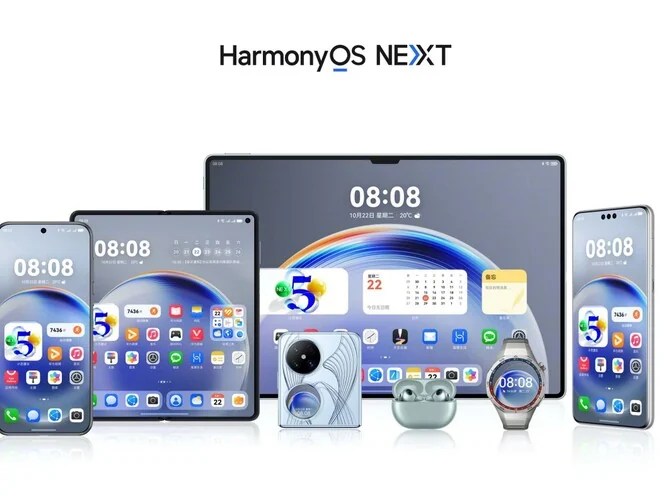
And then there's Huawei, building an escape hatch from the whole Android world. HarmonyOS NEXT, launched commercially in October 2024, runs on Huawei's own kernel with zero Android code and no Android app compatibility — every Huawei phone launched in China since 2025 runs it (GSMArena). The installed base passed 17 million devices by September 2025, and the newer HarmonyOS 6 was on more than 55 million by April 2026 (Silicon.co.uk). Most remarkably, HarmonyOS overtook iOS in China — 17% to 16% of new smartphone sales in Q2 2025, the sixth consecutive quarter in the lead (Counterpoint). App counts are a definitional mess — 15,000 native apps at launch versus "300,000 apps and meta-services" by late 2025, the latter padded with lightweight widgets — but the trajectory is unmistakable. A decade after Google left, China has produced a fully post-Google mobile stack.
Everyone's doing it
If Xiaomi is the most honest about the model — it files the numbers, after all — it is far from alone. Xiaomi pioneered in-system ads around 2015, and as one Chinese trade investigation put it, "OPPO and vivo followed, then Huawei, then Samsung" (Huxiu).
OPPO's ColorOS shows ads in the Phone Manager, App Market, file manager and Weather apps — documented in OPPO's own community tutorials teaching users to disable them, with a moderator conceding in October 2025 that ads in the Music and Videos apps "still can't be killed yet," and that the problem applies to "some regions except the EU" (OPPO Community). Its budget sibling realme ships around 58 pre-installed apps, about 10 of them paid third-party placements (UNB), plus a "Hot Apps and Games" folder on the default launcher that one guide bluntly calls "an official folder full of ads" (GetDroidTips). vivo dresses the same inventory in nicer clothes: "Hot Apps" and "Hot Games" folders "designed to look like app folders but in fact simply extensions of Vivo's digital storefront" (Tech Advisor), a V-Appstore that "spams you with notifications," and an install scanner that checks every Play Store download and then pitches trending apps (Gadgets360).
Huawei operates the most industrialized ad machine of all: Petal Ads, its full-stack advertising platform, claims over 700 million monthly active devices across 220+ markets, and by mid-2023 was handling 4 billion ad requests a day for 360,000+ publishers (Huawei Developers; IGDA). Even Huawei's restraint is situational — in June 2019, Booking.com ads appeared on the lock screens of P30 Pro owners across Europe and South Africa before the company yanked them, admitting "they should not be appearing on lock-screen interfaces" (The Verge).
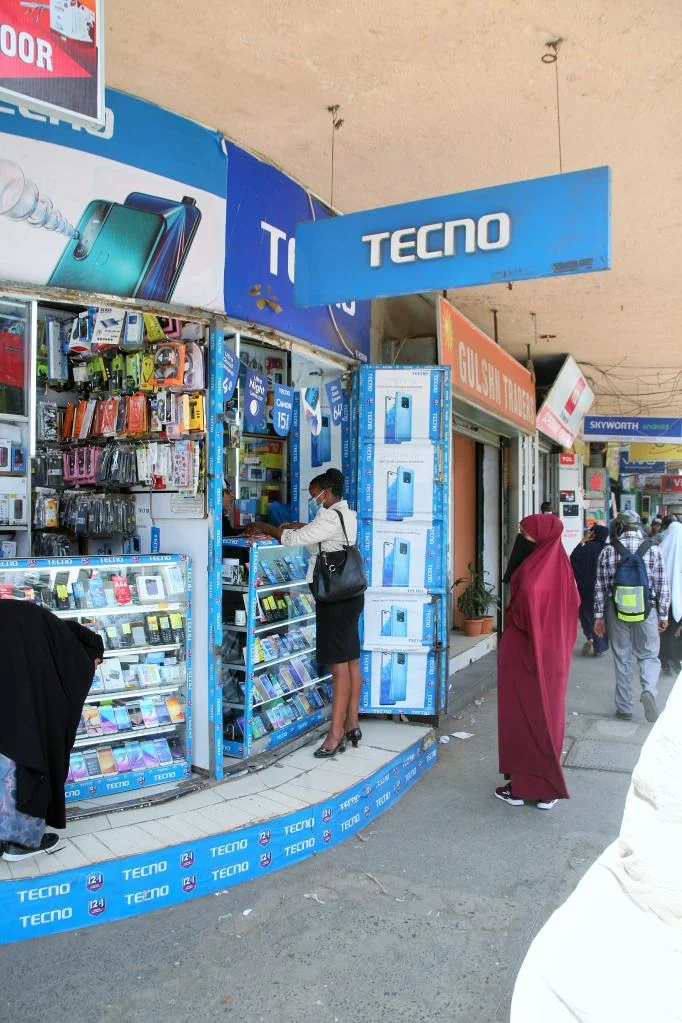
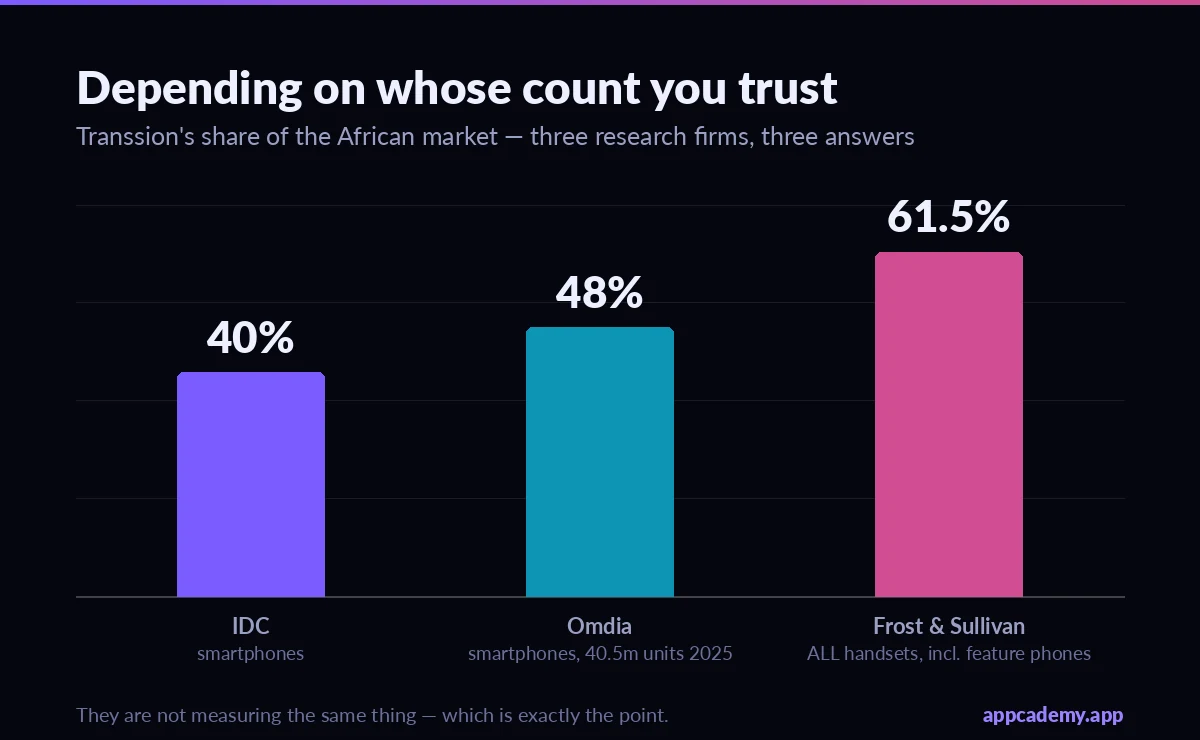
The extreme case is Transsion, the Shenzhen company most of the world has never heard of, whose Tecno, Infinix and itel brands dominate Africa. Depending on whose count you trust, Transsion holds roughly 40% of Africa's smartphone market (IDC), 48% (Omdia, 40.5 million units in 2025), or 61.5% of all handset sales including feature phones (Frost & Sullivan) — the numbers conflict because the scopes differ, but every version is a landslide (Gizmochina/Omdia). Many of these are sub-$100 phones — at this ultra-low-cost end of the market, the ad subsidy isn't a strategy; it's survival. Reviews of current Infinix devices describe XOS as "weighed down by heavy bloatware and persistent ads," with the Palm Store app store and AHA Games "can't easily be removed," and ads in notifications, the lock screen and even system settings (The Condia). The financials show why: Transsion's internet services earned just RMB 835 million in 2024 — barely 1.4% of revenue — but at an 80% gross margin, across a Transsion OS user base of more than 290 million (Sina Finance). When memory prices spiked in 2025 and Transsion's net profit crashed 53.5%, UBS noted that rising component costs hit hardest precisely at the low end that depends on ads and services to subsidize hardware (Yicai Global).
And at the darkest edge of this segment, the ecosystem literally ate its users. In 2020, security firm Upstream found Triada and xHelper malware pre-installed in the firmware of Tecno W2 phones — 19.2 million suspicious subscription-fraud transactions across 200,000+ devices in 19 countries, silently signing up low-income prepaid users in Ethiopia, Cameroon, Ghana and elsewhere for paid services. The malware survived factory resets. Transsion blamed "a vendor in the supply chain" (Upstream; PCMag). Not official policy — but a reminder of what thrives in the cracks of the ultra-cheap-phone economy.
Surely the premium end is safe? Ask a Galaxy owner. Samsung was showing ads in its Weather, Pay, Health and Themes apps on $1,200–$1,980 flagships until a backlash — including complaints from its own employees — pushed mobile chief TM Roh to remove them in late 2021 (The Verge). But the ads never fully left: Samsung's own policy confirms content apps like Game Launcher, Galaxy Store and Samsung Free still show third-party ads. And in March 2026, reviewers found the $1,300 Galaxy S26 Ultra shipping with Microsoft 365 Copilot, LinkedIn, Outlook, Spotify and Meta apps preinstalled by default — third-party apps alone eating over 17GB, with "each such preinstallation" being, per the report, "the result of commercial agreements" (Durov's Code/Android Authority). In June 2025, Samsung even partnered with Glance to put an AI-generated shopping experience on American lock screens — one that uses your selfie to render custom fashion ads (Ars Technica). Glance, for its part, is now installed on 450 million+ smartphones worldwide (TechCrunch).
The difference between Samsung and Xiaomi isn't principle. It's calibration. Samsung decided flagship buyers wouldn't tolerate system-app ads, so it retreated there and kept the preinstalls. Xiaomi calculated that budget buyers would grumble and adapt — and refused the kill switch. The industry has A/B tested your tolerance, and the results are in.
What this means for you
First, know that the same phone is two different products depending on where it's sold. A China-ROM Xiaomi has no Google services, a heavier ad stack, and Xiaomi's own store, search and payment rails to monetize; the Global ROM carries the Play Store and "fewer" ads — fewer, not zero, per comparison guides (Dr.Fone). Whether European units are truly ad-free is genuinely contested: some XDA guides claim EU system software ships clean, while Malaysian users on the Lowyat forums report that Global-ROM toggles "can turn off but ha[ve] no effect … Only EU rom is clean" — and other Malaysians on the same thread say a careful one-time setup leaves them ad-free for years (Lowyat). The honest summary: ads exist on global units; severity depends on your region, model, and patience.
The model is quietly going global on Xiaomi's balance sheet, too. GetApps — pre-installed on every global Xiaomi — claims over 260 million monthly active users outside China across 100+ markets, doing 30 million installs a day (Baidu Baike). Overseas internet services revenue hit RMB 12.6 billion in 2025 — 33.8% of the segment and its fastest-growing slice. What was perfected behind the Great Firewall is now an export.
If you're traveling in the other direction — into China — the mirror image applies. Google, WhatsApp, Instagram and most Western services are blocked on any locally routed connection, and the practical fixes are specific: a travel eSIM routed outside China (Holafly routes via Singapore, so blocked apps "work just fine"; but beware, Airalo's China eSIM rides China Mobile and does not bypass the firewall), international roaming on your home SIM, or a VPN — which you must install before arrival, because VPN sites are themselves blocked (Holafly; MicroEsim; Our Wander Story).
Now the privacy question, told straight, because the record is genuinely mixed. In 2020, security researcher Gabi Cirlig showed Forbes that Xiaomi's default browsers recorded every site he visited and every search he made — including in incognito mode — and sent the data, weakly encoded, to Alibaba-rented servers in Singapore and Russia; Xiaomi denied wrongdoing, then quietly shipped an update adding a toggle (CNET). In 2021, Lithuania's National Cyber Security Centre found that a Xiaomi Mi 10T 5G regularly downloaded a "MiAdBlacklistConfig" file containing 449 filterable terms — names of religious and political groups and social movements — with dormant code capable of blocking matching content, and urged citizens to throw away Chinese phones (MediaNama). Xiaomi countered that the list was ad-content management "to shield users from offensive content." Then Germany's federal cybersecurity agency, the BSI, ran its own months-long probe and concluded it "was unable to identify any anomalies that would require further investigation" (Asia Tech Press). Both findings stand. The capability existed on paper; no one proved it active on EU devices.
India has been the hardest line: it banned Xiaomi's Mi Community, Mi Video Call and later Mi Browser Pro in its 2020–21 waves of Chinese app bans (TechCrunch), and in 2022 its Enforcement Directorate seized $725 million of Xiaomi India's deposits in a royalty-remittance case — a financial dispute, not a privacy one, but a marker of how exposed the business model is to geopolitics (Reuters). In Europe, Max Schrems' noyb filed GDPR complaints against Xiaomi and five other Chinese apps in January 2025 over data transfers to China, seeking fines of up to 4% of global revenue; as of mid-2026, the cases remain pending (CPO Magazine).
If you'd rather fight back yourself, the playbook is well-worn and mostly free. Revoke MSA (Settings → Passwords & security → Authorization & revocation — expect to tap "Revoke" several times). Kill personalized ad recommendations under Privacy → Ad services. Then walk the per-app toggles: Security's "Receive recommendations," Downloads' "Show ads," the browser, Themes, the folder-level "Promoted apps," the lock-screen Glance/Carousel, GetApps notifications. For a system-wide catch-all with no PC and no root, set Android's Private DNS to dns.adguard-dns.com and most ads simply never load (XDA). Power users go further with ADB commands that uninstall the MSA package and GetApps for the current user — reversible, banking-app-safe, and documented in community repos with tiered safe-to-aggressive lists, though careless removal can bootloop a phone (shcho-i-yak; GitHub).
Two honest caveats. Toggles sometimes reset after system updates — some Mi Video settings reportedly expire after 90 days. And there remains no official master switch, on any current HyperOS build, that turns the whole apparatus off at once. The fifteen-minute de-ad ritual is, for now, part of the purchase price.
The takeaway
Step back and the story resolves into something cleaner than a privacy scare or a gadget gripe. The ads in your Security app are not an accident of sloppy software, and they are not creeping feature bloat. They are a calibrated, deliberate pricing feature — the mechanism that lets a RM549 phone exist at RM549. Xiaomi said as much in its IPO letter, proves it every quarter in the 76-percent-margin column of its results, and confirmed it in August 2024 when it refused, on the record, to give users a single off switch. Samsung proved the inverse: when the customer is paying $1,300, the calculus flips, the ads retreat to the store apps, and the monetization hides in preinstall contracts instead. Same industry, different price tier, precisely tuned tolerance.
That means the force most likely to change your phone isn't consumer outrage — there's been plenty — but regulation. The EU's Digital Markets Act has already forced Apple to make Safari and the App Store uninstallable, though Xiaomi, OPPO and vivo aren't designated gatekeepers, so the GDPR complaints route is the live one aimed at them (European Commission). India has drafted rules twice — 2023 and again in January 2026 — that would force all pre-installed apps to be removable, explicitly citing GetApps as the kind of unremovable preinstall it wants gone (Hindustan Times/Reuters). And Beijing, for its part, polices its own ecosystem harder than outsiders assume: MIIT's 2021 crackdown drove the rate of unclosable app pop-ups from 69% to nearly zero, and its 2022 rules already require non-essential preinstalled apps to be uninstallable inside China (Global Times; Trivium China). Governments, not markets, are drawing the borders of the ad phone.
What to watch next: whether HyperOS's rumored opt-out-at-setup ever ships; whether HarmonyOS NEXT — Android-free and now ahead of iOS in China — carries its ad model abroad as Huawei targets international expansion from 2026; whether the collapsing Hardcore Alliance forces Chinese phone makers to lean even harder on advertising as the 50% game tax erodes; and above all, the lock screen. Glance is on 450 million phones, Samsung is already serving AI-generated ads built from your selfie in the US, and every OEM has learned that the screen you glance at a hundred times a day is the most valuable inventory on the device.
The cheap phone was never cheap. It's a payment plan — and the currency is your attention. The only real choice on offer is whether you spend fifteen minutes canceling the installments, or let them run.
Sources
- Xiaomi 2025 Annual Report — Xiaomi IR, 2026
- Xiaomi FY2024 Annual Results Announcement — Xiaomi IR, 2025
- Xiaomi Q2 2026 Results Announcement — Xiaomi IR, 2026
- Xiaomi promises to give money back to customers if its profits get too high — TechCrunch, 2018
- Xiaomi admits to putting ads in the settings menu of its phones — The Verge, 2018
- Xiaomi promises less bloatware in HyperOS 2, but no on/off toggle for ads — AndroidKenya, 2024
- How to remove ads in Xiaomi phones (MIUI and HyperOS) — Gizmochina, 2025
- Google Play Store in China: Everything You Need To Know — AppInChina, 2026
- AppInChina App Store Index — AppInChina, 2026
- Tencent's 'Dungeon & Fighter' game pulled from some Android app stores — Reuters, 2024
- Tencent's mobile game Dungeon and Fighter withdrawn from major Android app stores — TechNode, 2024
- WeChat Statistics — DemandSage, 2026
- Huawei commits to HarmonyOS Next for all 2025 devices — GSMArena, 2024
- Huawei's HarmonyOS leads Apple in China for sixth quarter — Silicon.co.uk, 2025
- All apps and mini programs to be registered by end of March 2024 — China Briefing, 2023
- Transsion captures 48% as Africa smartphone market grows 13% in 2025 — Gizmochina/Omdia, 2026
- Triada/xHelper malware pre-installed on low-cost Android devices — Upstream, 2020
- Samsung confirms it's removing ads from its stock apps — The Verge, 2021
- Samsung teams up with Glance to use your face in AI-generated lock screen ads — Ars Technica, 2025
- German regulator says no evidence of censorship function in Xiaomi phones — Asia Tech Press, 2022
About the images. The charts here were drawn by us from the figures in the sources cited beside them. The photographs and screenshots are manufacturer press material (Xiaomi, Huawei, Glance) and screen captures documenting the software behaviour described. The remaining photographs and screenshots are reproduced from the publications credited beneath each one, used here to document the specific behaviour and market described in the text.